
First of all, in modern UK culture, there’s an uncomfortable truth most people don’t say out loud.
Recreational drug use — even “occasional” — has become normalised.
As a result, it’s part of nights out, framed as stress relief, and sometimes even as a reward.
In fact, this article is not about judgement.
Instead, this is about something much simpler — a clear comparison:
Cost. Experience. Long-term impact.
Moreover, what happens when you compare that lifestyle to something completely different:
Specifically, the answer is cycling.
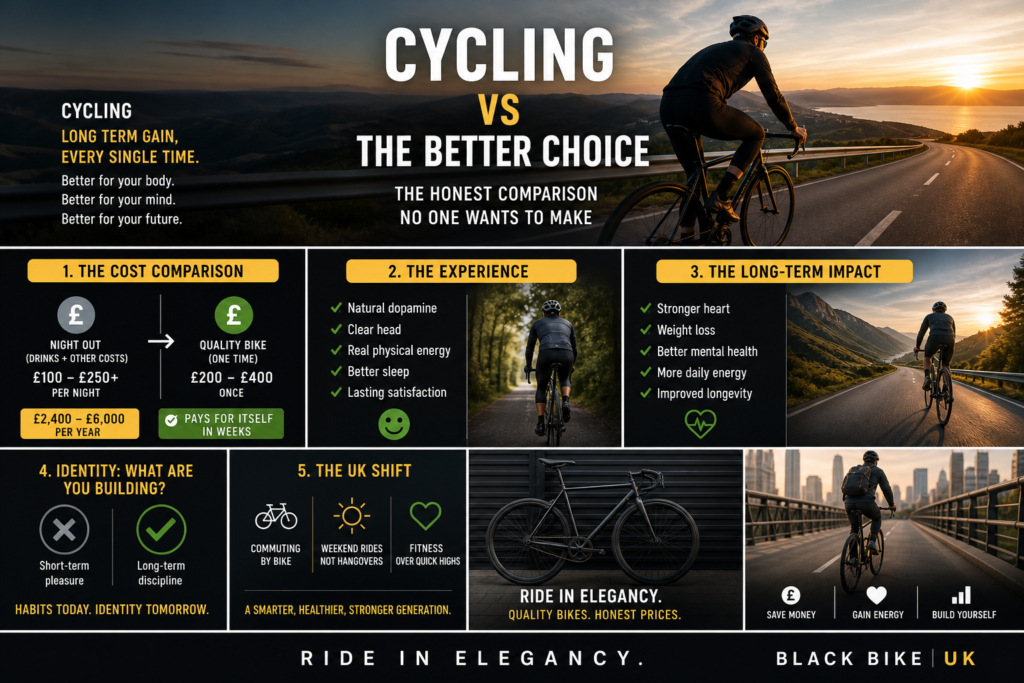
1. The Cost Comparison (No One Talks About This Honestly)
To begin with, let’s be real for a second.
For instance, a typical night out in the UK can easily include:
- £50–£150 on substances
- £30–£80 on drinks
- £20–£50 transport
Total: £100–£250+ in a single night.
Even so, do that twice a month?
£2,400–£6,000 per year.
By contrast, consider what cycling costs.
- One quality bike: ~£200–£400
- Maintenance: minimal
- Usage: unlimited
In fact, a bike pays for itself in weeks — not years.
2. The Experience: Short High vs Real Energy
To begin, let’s compare them honestly.
Occasional Drug Use
- Short-term euphoria
- Artificial stimulation
- Followed by a crash
- Often low energy the next day
Cycling
- Natural dopamine and endorphins
- Clear head
- Real physical energy
- Better sleep
On the one hand, one takes from your body.
In contrast, the other builds it up.
3. The Long-Term Impact
However, this is where the difference becomes serious.
Occasional Use Over Time
- Increased tolerance
- Higher spending
- Potential health risks
- Mental fatigue
Cycling Over Time
- Weight loss
- Stronger cardiovascular health
- Improved mental clarity
- Higher daily energy
Specifically, one compounds damage.
As a result, the other compounds growth.
4. Identity: What Lifestyle Are You Building?
Ultimately, this is the real question.
After all, because habits are not just actions — they shape identity.
Specifically, after 6 months:
- One path leads to dependency on external stimulation
- The other builds discipline, strength and confidence
Clearly, cycling is not just exercise.
Certainly, it’s control.
Additionally, it creates structure.
Furthermore, cycling fosters independence.
5. The UK Shift: Why More People Are Choosing Cycling
Notably, across the UK, more people are stepping away from expensive nightlife habits and choosing:
- Commuting by bike
- Weekend rides instead of hangovers
- Fitness over quick highs
Not simply because they have to.
Therefore, it simply makes more sense.
Ride in Elegancy — A Different Choice
Therefore, at Black Bike, we built our brand around a simple idea:
You don’t need to overpay to change your lifestyle.
Specifically, our bikes are:
- Professionally assembled in the UK
- Quality checked before dispatch
- Delivered fast across the UK
Consequently, one decision can shift everything.
Moreover, less money is wasted.
Additionally, more energy gained.
Ultimately, you become a stronger version of yourself.
Final Thought
To be clear, this isn’t about telling anyone what to do.
Rather, it’s about seeing the trade-off clearly.
In other words, it’s a choice between short-term escape and long-term control.
So, if you’re ready to make a change:
Ride in Elegancy.
Read more on our blog about cycling lifestyle and fitness tips.
Honestly, this really made me think. I used to spend so much money on nights out and felt rough for days afterwards. Started cycling to work about 8 months ago and the difference is massive — more energy, sleeping better, and I’ve actually saved a decent chunk of money. It’s mad how much you don’t realise you’re spending until you sit down and add it up. Great article, needed saying.
Never thought I’d read something that made me genuinely reconsider my weekends but here we are. The identity section hit differently — cycling really does build something in you over time whereas the other path just keeps costing you. Been riding for 3 months now and the difference in how I feel on Monday mornings is remarkable.
Interesting perspective, but in reality the difference is even simpler — after “occasional use,” the next couple of days are often effectively written off, both physically and mentally.
With cycling, it’s the opposite — you can hop on a bike almost anytime, and the result is a clear head, energy, and a good mood. That’s why, in my view, the comparison is actually too generous to the other side.